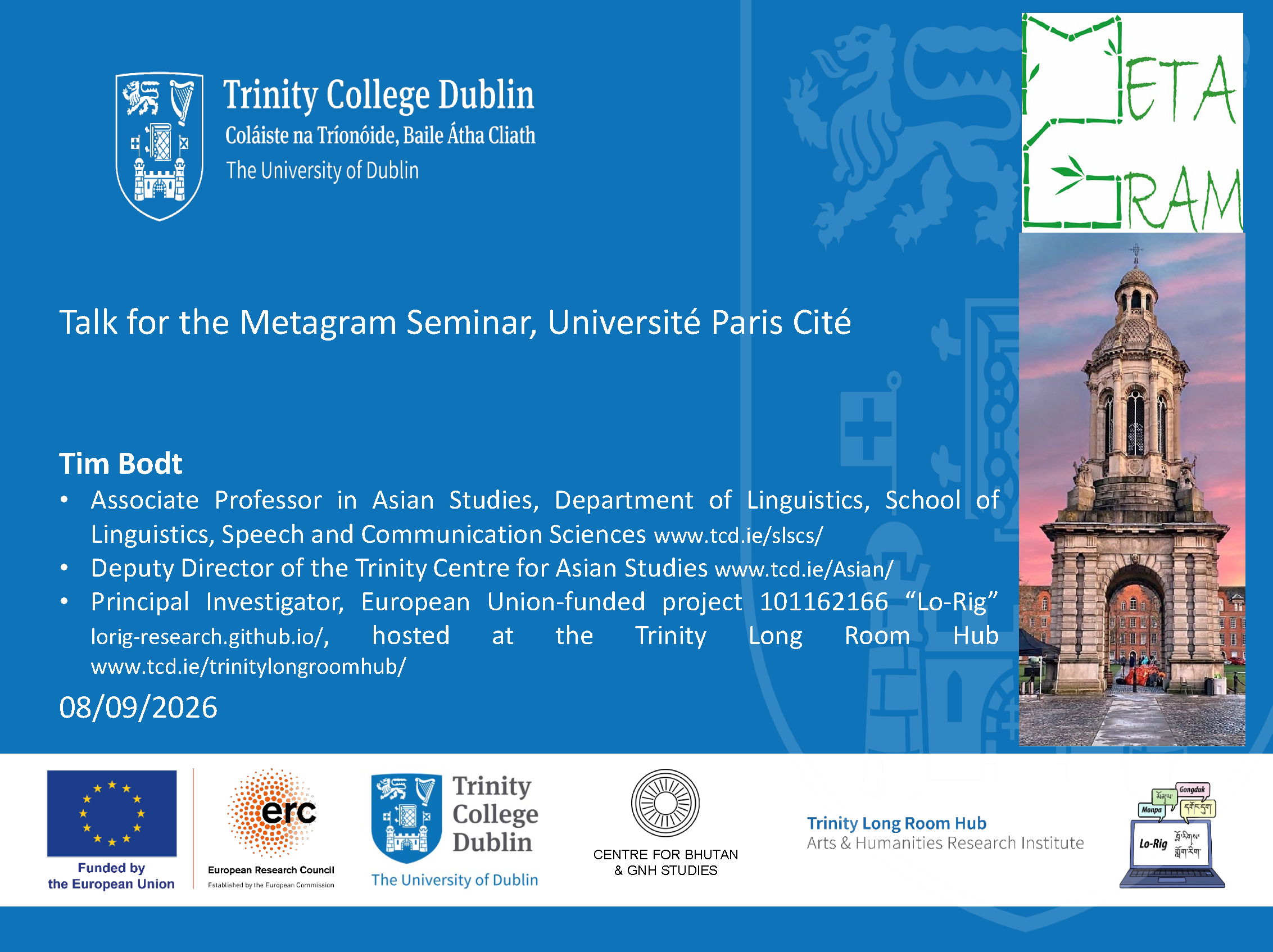
On the invitation of Aimée Lahaussois, Lo-Rig Principal Investigator Tim Bodt presented a talk on grammar writing at the Metagram seminar series on 8 September 2026. The seminar series is organised by Aimée Lahaussois and Yvonne Treis and Tim's presentation was attended by 40 students and researchers from across the globe with an interest in language documentation and description.
Presentation Slide Title Page
More information is available through the following links:
From 31 August to 4 September 2026, Tshering Om Tamang participated in the 2026 Summer School “Language Science Meets Linguistic Diversity” at Humboldt-Universität zu Berlin, Germany. The week-long summer school was jointly organised by the Endangered Languages Archive (ELAR), Humboldt-Universität zu Berlin, and the Leibniz-Zentrum Allgemeine Sprachwissenschaft (ZAS).
Tshering attended three courses: Digital Tools for Annotation and Analysis of Language Documentation Data (ELAN, FLEx), Data Management and Metadata Creation for Archiving in Language Documentation, and Capturing Language Use. The courses combined theoretical sessions with intensive practical work, covering the use of ELAN and FLEx for transcription, annotation, and corpus development; approaches to organising, managing, documenting, and archiving language documentation materials; and hands-on work with audio and video recording equipment for capturing language use. The recording sessions also included reviewing recordings and considering how different equipment and recording approaches affect the quality of the data collected.
The training is particularly relevant to Tshering’s upcoming fieldwork in Bhutan, where she will travel to Cungseng and Riti to collect linguistic data for the documentation and grammatical analysis of Monkha. The skills gained in the summer school will support the recording of audio and video data in the field and the subsequent processing, annotation, organisation, and archiving of the materials.
The summer school also provided Tshering with an opportunity to meet researchers working on language documentation and linguistic diversity across a range of linguistic contexts, and to exchange practical approaches to documenting, analysing, and preserving endangered and under-resourced languages.
Recent reporting in Kuensel, Bhutan's national newspaper, has highlighted the infrastructure challenges affecting access to Jigmecholing and nearby Monpa communities during the monsoon season.
On 12 July 2026, the bridge providing access to the Monpa village of Riti, referred to as Ritey in the Kuensel article, was washed away by flooding caused by heavy monsoon rain. A temporary footbridge was later constructed, but the article reports continued concerns among residents about the need for a more durable bridge.
A second Kuensel article, published on 15 July 2026, reported on difficult road conditions along the Gelephu–Trongsa highway, especially around the landslide-prone Boxcut area. Jigmecholing serves as an important access point to the Monpa villages of Riti and Cungseng, where Lo-Rig project member Tshering Om Tamang conducts linguistic fieldwork.
These reports help illustrate the precarious infrastructure connecting remote communities in Bhutan and the practical challenges involved in conducting linguistic fieldwork in such areas.
The articles are available online through Kuensel:
The Lo-Rig project was mentioned in a recent article in Kuensel, Bhutan's national newspaper, titled "Gongdue Kha going extinct in Mongar". The article discusses the endangered status of Gongdue Kha and highlights current efforts to document and preserve the language. The Lo-Rig project is mentioned as part of these ongoing documentation efforts.
This media coverage helps draw attention to the urgency of language documentation work in Bhutan and to the importance of sustained collaboration with speaker communities in documenting, preserving, and promoting endangered languages.
Between 15 and 27 June 2026, Lo-Rig Principal Investigator Tim Bodt taught a class on "Reconstruction of Proto-(Western-)Kho-Bwa" at the Second Summer School for Ancient Trans-Himalayan Languages, organised by the Trinity Centre for Asian Studies at Trinity College Dublin.
The class worked with primary data on Bugun and showed how such linguistic data can be used to reconstruct a proto-language and compare these data with other, presumably related languages. The class included two practical sessions and was attended by around 40 on-site and online participants.
More information about the 2026 Summer School is available on the Trinity Centre for Asian Studies website:
Official banner for the first Lo-Rig Language Documentation and Description Workshop, "Linguistic Fieldwork", to be held in Thimphu from 30 November to 06 December 2026.
Workshop details
Title: Language Documentation and Description Workshop 1: Linguistic Fieldwork Dates: 30 November – 06 December 2026 Location: Centre for Bhutan and GNH Studies, Langjopakha, Thimphu, Bhutan Application deadline: 15 August 2026
The Lo-Rig project, in cooperation with the Centre for Bhutan and GNH Studies (CBS), is pleased to announce its first annual Language Documentation and Description Workshop. The first workshop, titled "Linguistic Fieldwork", will take place at CBS in Langjopakha, Thimphu, Bhutan, from 30 November to 06 December 2026.
This workshop is the first in a planned series of three annual workshops organised by the Lo-Rig project. The series aims to support language documentation and description work by bringing together community linguists, researchers, teachers, cultural officers, language advocates, and others interested in linguistic research and language preservation.
The first workshop will focus on linguistic fieldwork, including data collection, research ethics, recording practices, data storage, phonetics and phonology, orthographies, and the International Phonetic Alphabet (IPA).
Applications are open to participants from Bhutan, India, Nepal, Bangladesh, and Pakistan. The application deadline is 15 August 2026, with acceptance communicated by 15 September 2026.
For full details, including eligibility, funding support, workshop planning, and application information, please see the official announcement:
From 1 June 2026, the Lo-Rig project is housed in the Trinity Long Room Hub Arts & Humanities Research Institute at Trinity College Dublin.
The Trinity Long Room Hub is Trinity's research institute for the Arts and Humanities. Its research community spans more than twenty disciplines, including languages, literatures, cultural studies, linguistics, history, education, and the University Library. Its current research priorities also include human-centred approaches to technology.
This makes the Hub a supportive institutional setting for Lo-Rig's work on language documentation, linguistic description, community collaboration, and AI-assisted workflows for under-resourced languages.
Following its initial setup period with the School of Linguistic, Speech and Communication Sciences, Trinity College Dublin, Lo-Rig is grateful for the support received during that stage and looks forward to continuing its work within Trinity's wider arts and humanities research community.
The move gives the project a clear institutional base within Trinity College Dublin as it continues its work on the documentation and description of Gongduk and Monkha, and on the development of AI-assisted workflows to support language documentation.
More information about the Trinity Long Room Hub is available on its website:
The Lo-Rig project's PhD student, Tshering Om Tamang, arrived at Trinity College Dublin on 28 April 2026. In her first week, she has been settling into life on campus, meeting fellow researchers at the Trinity Centre for Asian Studies (TCAS), and completing key administrative steps such as obtaining her student ID card. Her arrival followed delays related to visa procedures and flight restrictions. She has also begun familiarising herself with Trinity's academic systems, libraries, and research facilities, as well as navigating life in Dublin. Looking ahead, she hopes her four years at Trinity will be intellectually rewarding, offering opportunities for meaningful research, collaboration, and personal growth. She particularly looks forward to advancing her research on the Monkha language as part of the Lo-Rig project.
PhD student, Tshering Om Tamang, at Trinity College Dublin (April 2026).
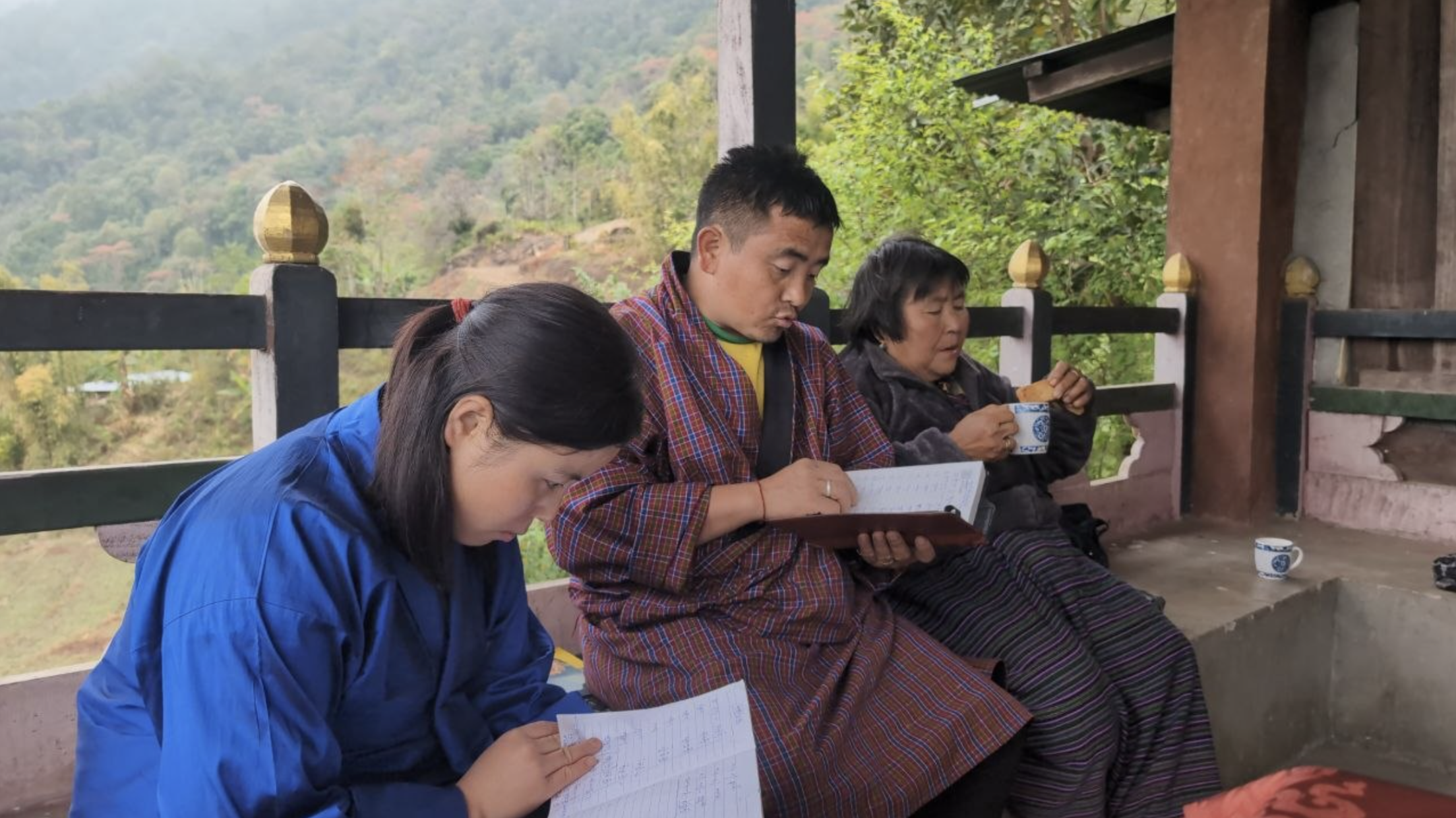
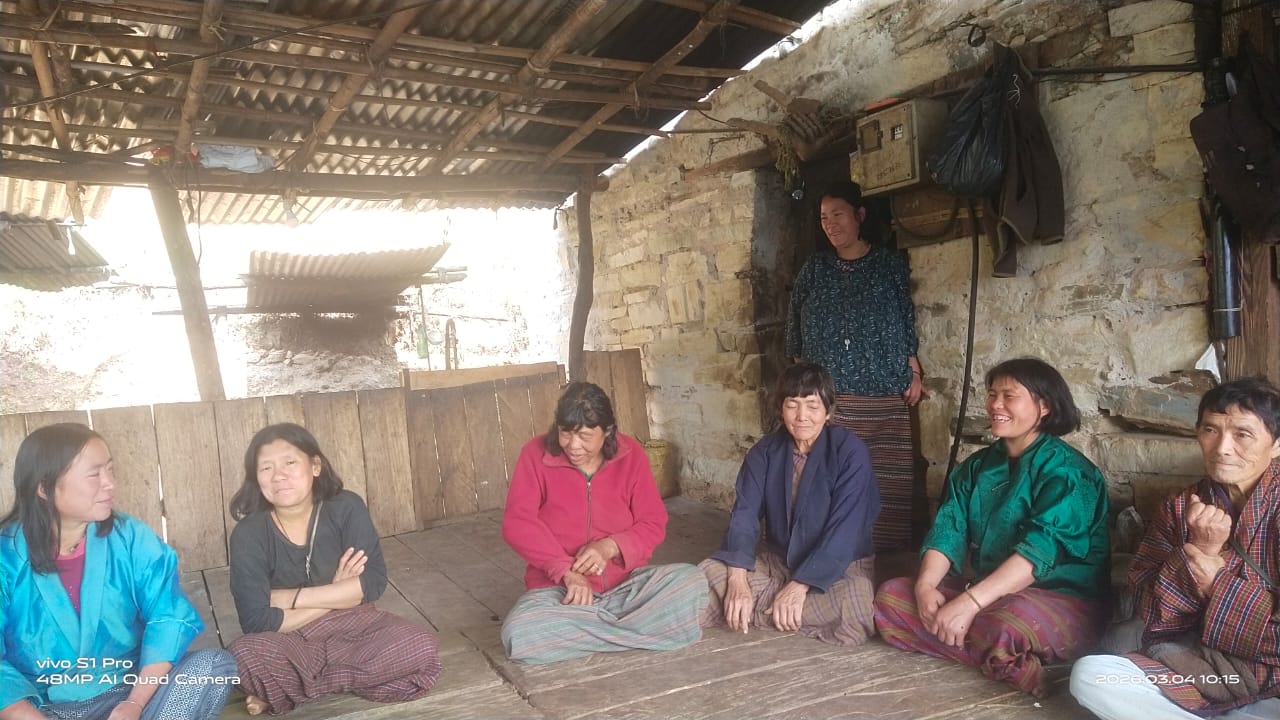
Between 13th and 17th March 2026, Ms Tshering Om Tamang and Sonam Lhamo visited Chungseng village to carry out fieldwork on the Monkha language.
During the visit, the researchers collected primary data on local language use and community perspectives. An important activity was a community meeting, where the team introduced the aims and scope of the Lo Rig Project, with particular focus on documenting Monkha language. Following the presentation, community members shared their knowledge, experiences, and perspectives on language preservation.
Alongside the meeting, Ms Tshering and Sonam Lhamo collected language samples from speakers in the village. They recorded natural conversations and oral narratives to capture everyday speech and elicited word lists to document the vocabulary of the Monkha language. These focused efforts aimed to provide an accurate record of authentic language use to support ongoing documentation and preservation of Monkha.
Community members attending a meeting in Chungseng village (March 2026).
Fieldwork data collection session in Chungseng village (March 2026).
Rinchen visited the remote Gongduk communities of Pam, Caibi and Miden, where he introduced the Lo-Rig project, held consultations with community members, and conducted the sociolinguistic survey.
Due to the lack of a guide, he was unable to visit Bangbangla, possibly the most remote Gongduk village. A future visit is planned for autumn 2026.
People from Miden village attending the consultative meeting about the Lo-Rig project (March 2026).