Between 15 and 27 June 2026, Lo-Rig Principal Investigator Tim Bodt taught a class on "Reconstruction of Proto-(Western-)Kho-Bwa" at the Second Summer School for Ancient Trans-Himalayan Languages, organised by the Trinity Centre for Asian Studies at Trinity College Dublin.
The class worked with primary data on Bugun and showed how such linguistic data can be used to reconstruct a proto-language and compare these data with other, presumably related languages. The class included two practical sessions and was attended by around 40 on-site and online participants.
More information about the 2026 Summer School is available on the Trinity Centre for Asian Studies website:
Official banner for the first Lo-Rig Language Documentation and Description Workshop, "Linguistic Fieldwork", to be held in Thimphu from 30 November to 06 December 2026.
Workshop details
Title: Language Documentation and Description Workshop 1: Linguistic Fieldwork Dates: 30 November – 06 December 2026 Location: Centre for Bhutan and GNH Studies, Langjopakha, Thimphu, Bhutan Application deadline: 15 August 2026
The Lo-Rig project, in cooperation with the Centre for Bhutan and GNH Studies (CBS), is pleased to announce its first annual Language Documentation and Description Workshop. The first workshop, titled "Linguistic Fieldwork", will take place at CBS in Langjopakha, Thimphu, Bhutan, from 30 November to 06 December 2026.
This workshop is the first in a planned series of three annual workshops organised by the Lo-Rig project. The series aims to support language documentation and description work by bringing together community linguists, researchers, teachers, cultural officers, language advocates, and others interested in linguistic research and language preservation.
The first workshop will focus on linguistic fieldwork, including data collection, research ethics, recording practices, data storage, phonetics and phonology, orthographies, and the International Phonetic Alphabet (IPA).
Applications are open to participants from Bhutan, India, Nepal, Bangladesh, and Pakistan. The application deadline is 15 August 2026, with acceptance communicated by 15 September 2026.
For full details, including eligibility, funding support, workshop planning, and application information, please see the official announcement:
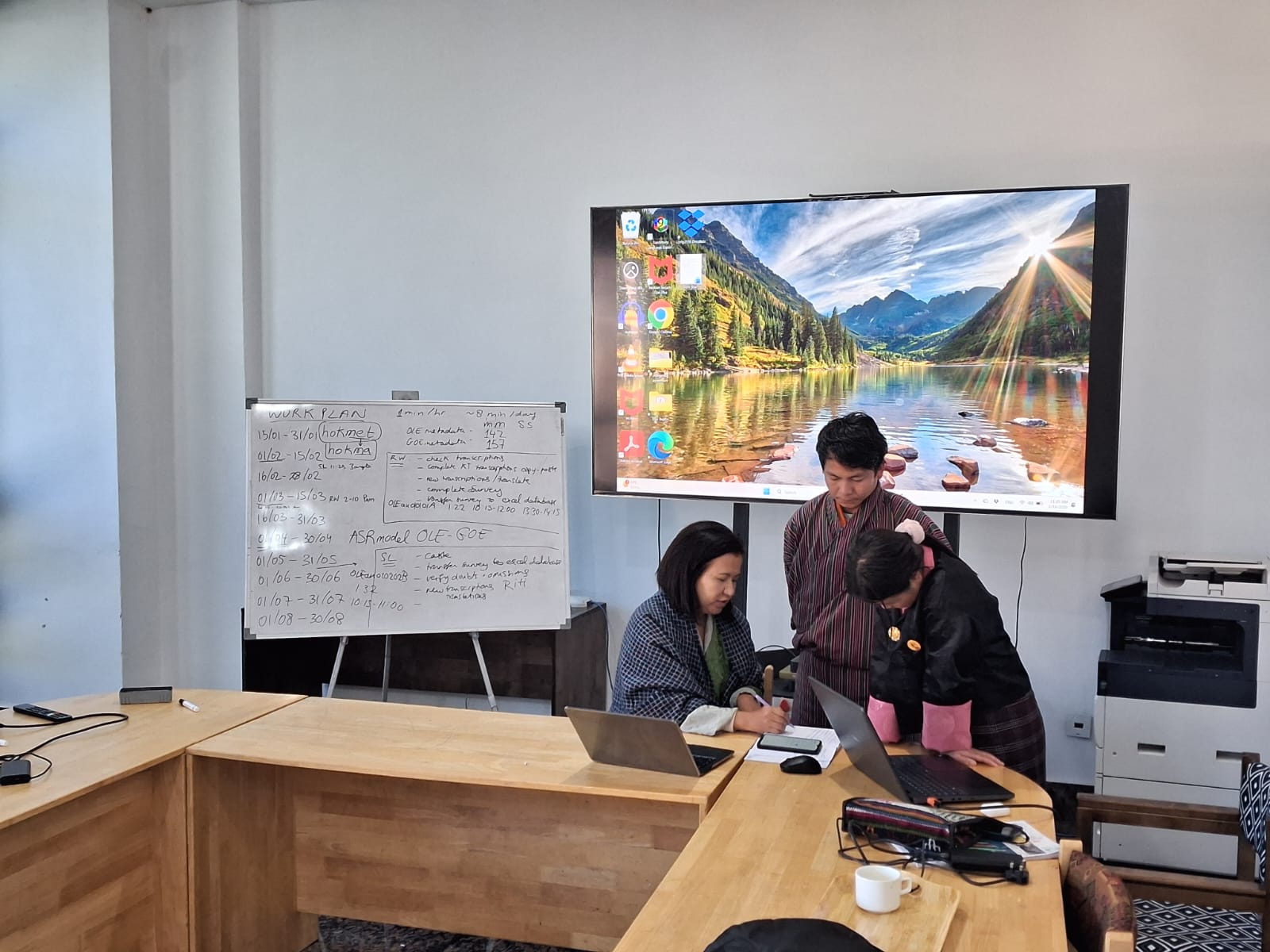
Tim continued with training the Research Assistants Sonam and Rinchen at the Center for Bhutan and GNH Studies in Thimphu. They had made Monpa speech communities and with the transcription and translation of the recordings. This week, the Lo-Rig team was also joined by Ms. Tshering Om Tamang, the PhD candidate for the Lo-Rig project who will work on the documentation and description of Monkha. Together, the team discussed the research in detail and made a planning for the coming months.
Tshering sharing her knowledge and skills with Sonam and Rinchen during Research Assistant training in Thimphu (January 2026).
Between 06 and 24 October and between 17 and 28 November 2025, the project PI Tim conducted a training programme for the two Bhutanese Research Assistants, Sonam and Rinchen. The training commenced with an introduction to the Lo-Rig project goals and objectives, the project staff, and the work packages and planning for the five years of the project.
The Research Assistants were also introduced to the field of linguistics, including topics such as basic phonetics and phonology and the International Phonetic Alphabet (IPA), parts of speech, verbal agreement including the project's focus on biactantial and polypersonal verbal agreement, orthographies and orthography development, and the linguistic diversity of Bhutan.
The two Research Assistants were familiarised with important topics such as research ethics, data protection, informed consent, open access, and cybersecurity. The Participant Information Leaflets (PILs) and Informed Consent Forms developed at Trinity College Dublin were translated into Dzongkha and subsequently summarised and translated into Gongduk and Monkha.
The Research Assistants were introduced to best practices in linguistic fieldwork. They translated the regionally relevant wordlist into Dzongkha and Tshangla and practised elicitation and transcription in their respective languages, Monkha and Gongduk.
The Research Assistants also practised using the recording equipment in different contexts and conditions. A field visit was made to the Folk Heritage Museum in Canggangkha, Thimphu, to gain an understanding of the types of household items, tools, and practices that would be of interest for elicitation and recording in their respective communities.
The Research Assistants received their project laptops, and the required software was installed on them. Tim explained the ELAN–FLEx workflow and the potential scope and benefits of applying Automatic Speech Recognition to speed up the transcription of recordings. They then practised the manual transcription of recordings in ELAN.
On 15 June 2025, Lo-Rig Principal Investigator Tim Bodt gave the opening talk for the First Summer School for Ancient Trans-Himalayan Languages, organised by the Trinity Centre for Asian Studies at Trinity College Dublin.
The talk focused on the possible use of the Tibetan script for writing Tshangla, a language spoken in eastern Bhutan, western Arunachal Pradesh, and southeastern Tibet. The talk was attended by around 80 on-site and online participants of the Summer School.
More information about the 2025 Summer School is available on the Trinity Centre for Asian Studies website: